

How AI Reads Political Sentiment: A 2026 Guide
AI reads political sentiment by converting political language into numerical scores that measure emotional polarity and intensity. Using natural language processing (NLP) models, these systems detect tone, sarcasm, and contextual nuance across text, images, and video at a scale no human team could match. The industry term for this process is computational sentiment analysis, and its application to political discourse has accelerated sharply since 2024. GPT-4 achieves up to 95% agreement with human experts when classifying negative political rhetoric in tweets, and 82% agreement on broader three-category sentiment classification. That level of performance has made AI a credible substitute for manual annotation in political research.
Here is what AI actually evaluates when processing political content:
- Polarity: whether the text is positive, negative, or neutral
- Intensity (magnitude): how strongly the emotion is expressed
- Tone and nuance: irony, sarcasm, coded language, and implicit meaning
- Contextual framing: the political event or figure the text references
- Multimodal signals: visual and audio cues in images and video alongside text
- Stance indicators: the writer’s attitude toward a specific subject, not just the overall mood
Accuracy callout: GPT-4 reaches 95% agreement on negativity classification in political tweets and 82% on broader sentiment, benchmarked against expert human coders.
What AI methods power political sentiment analysis today?
The backbone of modern AI political analysis is the transformer architecture. Models like GPT-4 and domain-specific tools such as ParlaSent represent two ends of the spectrum: general-purpose large language models versus fine-tuned political specialists. ParlaSent builds on XLM-RoBERTa, a multilingual transformer pre-trained on a large corpus of parliamentary debates from multiple European parliaments. It matches GPT-4 performance in zero-shot sentiment classification while running significantly faster and at lower cost.
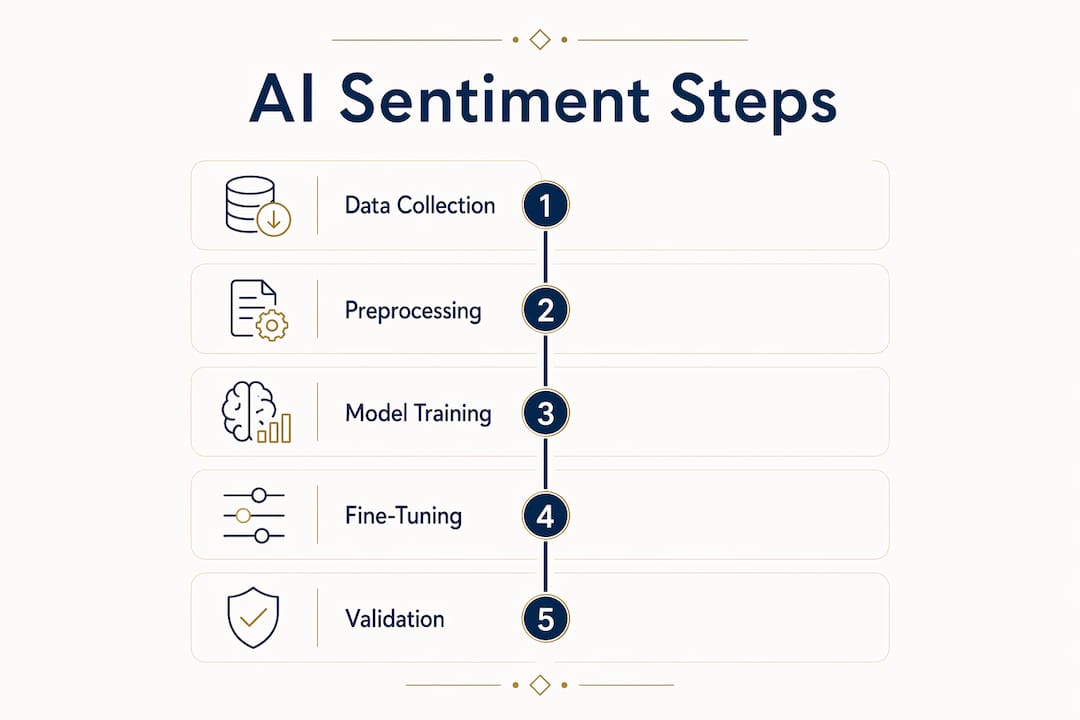
Transfer learning is the key technique here. A model pre-trained on massive text corpora learns general language patterns, then gets fine-tuned on labeled political datasets, such as congressional tweets or legislative transcripts. This approach requires far less hand-labeled training data than traditional machine learning, which previously demanded thousands to tens of thousands of annotated examples per task.

Researchers have also developed more granular coding schemas. Rather than a simple positive/negative/neutral split, six-level schemas capture gradations from strongly negative to strongly positive, giving political scientists a richer variable to work with in regression models. NLP techniques now detect sarcasm, irony, and coded political language by analyzing context windows rather than isolated keywords, which is why “not bad” registers as mildly positive and “I expected better” reads as critical.
Current state-of-the-art techniques in political sentiment analysis:
- Transformer fine-tuning: domain-specific pre-training on parliamentary corpora (e.g., ParlaSent on ParlaMint and EuroParl datasets)
- Transfer learning: initializing models on large general corpora, then adapting to political text
- Chain-of-thought prompting: guiding the model through intermediate reasoning steps to improve nuanced classification
- Few-shot prompting: providing a small number of labeled examples within the task description
- Cross-target tuning: using annotated data from related political tasks to improve performance on new targets
- Multimodal analysis: processing text, images, and video together for comprehensive sentiment classification
- Hybrid human-AI coding: AI performs initial annotation; human experts resolve disagreements
Common data sources include congressional Twitter feeds, news articles, parliamentary transcripts, Reddit discussions, and broadcast debate transcripts.
How accurate is AI at reading political sentiment, and where does it fall short?
Performance varies sharply by task and text format. The 95% agreement figure applies specifically to binary negativity classification in short tweets. Broader sentiment classification across three categories drops to 82%. Accuracy falls further on longer news articles, where maintaining context across paragraphs is genuinely hard for current models.
Accuracy variance: LLM coding accuracy is highest on short texts like social media posts, with performance declining on longer, complex news articles where context is harder to sustain.
Sentiment analysis and stance detection are related but distinct tasks, and conflating them produces misleading results. Sentiment analysis captures the overall emotional tone of a text. Stance detection goes further, identifying the writer’s attitude toward a specific subject, even when multiple subjects appear in the same text. A tweet can be broadly negative in tone but express support for one candidate while attacking another. Only stance detection captures that distinction, which is why it matters for tracking political polarization and media bias.
The hybrid coding approach addresses accuracy gaps directly. AI classifies all text at least twice; where the two runs disagree, a human expert adjudicates. This process boosts accuracy across all variables while keeping manual labor below 10% of the full dataset.
Key limitations and how researchers address them:
- Sarcasm and irony: context-window NLP and chain-of-thought prompting improve detection, but edge cases remain
- Short text ambiguity: tweets lack context; cross-target tuning with party affiliation data partially compensates
- Multi-language challenges: GPT-4 performs slightly lower on non-English text, though performance stays viable
- Bias in training data: anchoring models to verified primary sources reduces inherited bias
- Coded political language: Bible quotes, regional slang, and dog-whistle rhetoric require contextual knowledge the model may or may not have learned
- Ideology scaling: GPT-4 reaches substantial agreement on ideology classification, although this task is more challenging than negativity detection.
Pro Tip: When running AI sentiment analysis on political text, always run the model at least twice and flag disagreements for human review. That hybrid step is what pushes accuracy from good to research-grade.
Why integrating AI sentiment with faith and socio-economic context matters
AI-derived sentiment data does not interpret itself. A spike in negative political sentiment in congressional tweets during a debt-ceiling debate means something different when you understand the financial futures market reaction running in parallel. Sentiment scores become genuinely useful when layered with economic indicators, historical precedent, and, for Joshthinks readers, faith-based frameworks that shape how communities respond to political rhetoric.
Political leaders have long used emotional framing to connect with voters, and negative framing in particular drives affective polarization. AI can now quantify that dynamic at scale. But the ethical risks are real. LLMs can infer hidden political alignment from seemingly apolitical text, including band preferences, slang, and cultural references, raising genuine privacy concerns. Any organization using AI for political sentiment tracking needs clear boundaries on what data gets analyzed and how results get used.
For readers exploring the intersection of AI and political discourse, the practical value is in combining AI sentiment outputs with verified source anchoring. Systems that extract stated positions from official government records rather than editorial interpretations produce more impartial analysis. That principle applies equally to biblical economic frameworks: when AI interprets scripture in a political context, prompting the model to explain its reasoning step by step produces more defensible and contextually grounded outputs than a bare classification.
Interdisciplinary benefits and ethical best practices:
- Election forecasting: sentiment trends in congressional social media predict campaign tone shifts before polling data captures them
- Public opinion monitoring: tracking sentiment across news, social media, and legislative debate reveals polarization patterns in near real time
- Faith-based narrative analysis: AI can flag emotionally charged scriptural references in political speech, useful for understanding voter mobilization
- Bias mitigation: anchor AI models to primary sources (official transcripts, government records) rather than secondary editorial content
- Transparency: require AI systems to explain their classifications, especially for coded or culturally specific language
- Privacy guardrails: limit inference tasks to public political speech; avoid using AI to infer private political beliefs from non-political behavior
Pro Tip: Ask your AI model to “motivate your response” when classifying politically or scripturally ambiguous text. The reasoning it produces often reveals whether the classification is grounded in genuine contextual understanding or a shallow pattern match.
Joshthinks applies exactly this kind of layered thinking, connecting AI sentiment insights with political analysis, historical context, and faith-informed economic frameworks to give readers a fuller picture than any single discipline provides.
Key Takeaways
AI reads political sentiment most accurately when NLP models are fine-tuned on domain-specific political data, validated through hybrid human-AI review, and anchored to verified primary sources.
| Point | Details |
|---|---|
| Accuracy peaks on short texts | GPT-4 achieves 95% accuracy on tweet negativity classification and 82% accuracy on broader sentiment classification. |
| Sentiment vs. stance detection | Sentiment captures overall tone; stance detection identifies attitude toward a specific subject, which is essential for tracking polarization. |
| Hybrid coding boosts reliability | Running AI annotation twice and having humans adjudicate disagreements pushes accuracy above what either approach achieves alone. |
| Verified sources reduce bias | Anchoring AI models to official government records and primary transcripts produces more impartial political analysis. |
| Context multiplies value | AI sentiment scores gain real meaning when combined with economic data, historical patterns, and faith-based interpretive frameworks. |


