

How to Research Primary Historical Sources: A Student’s Guide
Primary historical sources are original, contemporaneous records created by witnesses or participants in an event. Start your search at three places: the National Archives (NARA), the Library of Congress digital collections, and the Gilder Lehrman Institute of American History. These three repositories cover the widest range of U.S. federal, political, and social history materials, and all offer free digital access.
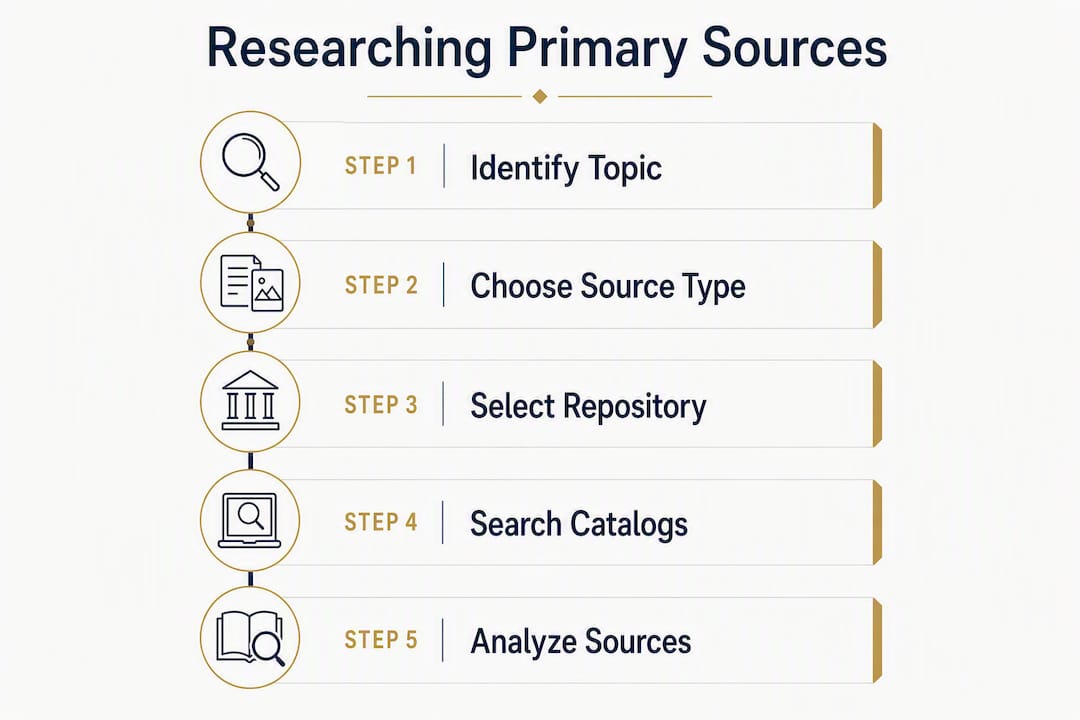
Before you open a single catalog, do this:
- Convert your topic into the record types it would have generated. A labor strike produces union broadsides, police reports, company correspondence, and local newspaper coverage, not a folder labeled “strike.”
- Run targeted catalog queries using those record types, creator names, date ranges, and geographic filters.
- Pull the finding aid for any collection that looks relevant. Finding aids are folder-level inventories, and they reveal material that never appears in keyword searches.
- Contact an archivist early. Reference services at NARA, LOC, and most university libraries are free, and archivists routinely point researchers to uncataloged material.
Joshthinks covers historical events and their policy implications in depth, and the research workflow below is the same one that underpins that kind of analysis.
Table of Contents
- What counts as a primary source?
- Where should you look for U.S. primary sources?
- How do you turn a topic into effective catalog searches?
- How to analyze a primary source step by step
- Access, reproduction, copyright, and citation
- Teacher and student resources worth bookmarking
- Researcher tips and common pitfalls
- How do you handle incomplete or biased sources?
- What limits access to certain primary sources?
- Which digital tools help you analyze primary sources?
- Key Takeaways
- Why primary-source rigor matters more than people admit
- Authoritative portals to bookmark
What counts as a primary source?
Primary sources are original materials created during the period under study or by people who directly experienced the events. That definition is broader than most students expect. It includes government records, congressional reports, agency files, diaries, letters, photographs, maps, newspapers, oral histories, speeches, scientific data, and physical artifacts such as clothing or buildings.
Two categories trip people up. First, oral histories and autobiographies recorded years after the fact still qualify as primary sources because they come from direct participants. Second, format does not determine status. A digitized scan, a microfilm copy, or a published transcription can all be primary sources as long as they derive from the original record. What matters is origin, not medium.
Translating a research topic into source types is a skill worth practicing. Researching a local factory strike? The primary record trail includes union meeting minutes, company payroll ledgers, police arrest logs, and coverage in the local newspaper. Researching a Civil War regiment? Think muster rolls, pension applications, and regimental order books, not just “Civil War letters.” The more specific the record type, the more targeted your search.
Pro Tip: When you are unsure what records a historical event would have created, ask: who had a reason to write something down? Government officials, lawyers, journalists, and business owners all generated paper trails. Start with the most bureaucratic actor involved.
Where should you look for U.S. primary sources?
The answer depends on whether your topic is federal, local, or somewhere in between. Here is a practical breakdown.
National Archives (NARA) and DocsTeach are the first stop for federal records: military service files, pension applications, executive agency correspondence, census records, and congressional materials. The National Archives Catalog is searchable by keyword, record group, and geographic area. DocsTeach, NARA’s teaching portal, pairs digitized documents with analysis worksheets covering photographs, written documents, maps, cartoons, and sound recordings.
Library of Congress is strongest for 19th- and early 20th-century American materials. Its digital collections include photographs, maps, manuscripts, and the Chronicling America historic newspaper archive, which covers thousands of U.S. newspapers from 1770 to 1963. LOC also offers an Ask a Librarian service that can help locate specific documents.
Gilder Lehrman Institute of American History provides curated, classroom-ready primary source sets focused on U.S. political and social history. Its collection search is organized by period and theme, making it especially useful when you need a vetted set of documents rather than raw catalog results.
University special collections and state archives are the right call when your topic has a local footprint. A state labor dispute, a regional religious movement, or a city’s urban renewal project will have records that never made it to a federal repository. Use university finding aids and state archives portals to identify relevant collections.
Digitized aggregators such as HathiTrust (accessible through most library portals) and the Internet Archive are useful for out-of-copyright books, pamphlets, and newspapers. They are not substitutes for archival collections, but they fill gaps quickly.
| Research need | Best starting point |
|---|---|
| Federal military or agency records | NARA Catalog |
| Historic U.S. newspapers | Chronicling America (LOC) |
| Curated classroom primary source sets | Gilder Lehrman Institute |
| Local or regional history | State archives / university special collections |
| Out-of-copyright books and pamphlets | HathiTrust / Internet Archive |
How do you turn a topic into effective catalog searches?
Generic keyword searches return generic results. The shift that separates productive archival research from frustrating browsing is searching for records of activity rather than topic names. Instead of searching “Revolutionary War,” search “regimental muster rolls” or “pension applications, Continental Army.” The record type narrows the result set to actual primary documents.
Metadata fields to use in most catalogs:
- Creator: the person, office, or agency that produced the record
- Date range: narrow to the years the event occurred, then expand if results are thin
- Geographic/Place: state, county, city, or military district
- Collection or series title: often more precise than subject headings
- Document type: letter, map, photograph, broadside, transcript
- Subject headings: useful for browsing but less precise than record-type searches
Boolean patterns help. In the LOC catalog, "factory inspection" AND "Pennsylvania" AND 1900-1920 returns far tighter results than “Pennsylvania factories.” In Chronicling America, you can filter by state, date range, and newspaper title simultaneously.
When results are thin, broaden the date window by a decade in each direction, try variant spellings (especially for 18th- and 19th-century names), and search for related organizations or successor agencies that might have inherited the records.
Pro Tip: Before spending hours in a catalog, email the repository’s reference desk with a two-sentence description of your topic and the time period. Archivists often respond within a day or two and can name specific record groups or collections that are not discoverable through public search interfaces.
How to analyze a primary source step by step
DocsTeach and NARA recommend a four-step method that works for any source type: documents, photographs, maps, artifacts, or sound recordings.
-
Meet the document. Identify the basics before reading closely. What type of source is it? Who created it, and when? Where was it created? Note the repository, collection title, box and folder number, and any item identifier or digital object identifier (DOI) right now, before you forget.
-
Observe its parts. Work through the source systematically. For a written document: read it once for overall meaning, then again for specific details. Note words, phrases, or sections you do not understand. For a photograph or map: describe what you see before interpreting it. What is present? What is absent?
-
Try to make sense of it. Ask interpretive questions. Why was this created? Who was the intended audience? What does the creator want the reader to believe or do? What might the creator have left out, and why? Cross-check your interpretation against at least one other source, because primary materials often lack context and must be read against other evidence to build an accurate picture.
-
Use it as historical evidence. Decide what the source proves, what it suggests, and what it cannot tell you. A single document is a data point, not a conclusion. Note any interpretive uncertainty in your research log so you can revisit it later.
The Library of Congress Primary Source Analysis Tool offers a printable worksheet that walks through observing, reflecting, questioning, and investigating further, and it works for any source type.
Access, reproduction, copyright, and citation
Getting the material you need involves a few distinct steps, and the path differs depending on whether the item is digitized.
- Digital access: — Most NARA, LOC, and Gilder Lehrman materials are freely available online. Download high-resolution images directly from catalog pages. Note the URL and the catalog item number for your citation.
Teacher and student resources worth bookmarking
Three portals stand out for classroom use, and each serves a slightly different purpose.
- LOC Primary Source Sets: — The Library of Congress packages curated sets of documents, photographs, and maps around specific topics (immigration, the Civil Rights Movement, World War I). Each set includes a teacher’s guide with discussion questions and suggested activities.
For remote learners, all three portals work entirely online. Students can annotate digitized documents using tools like Hypothesis or Google Docs comments, and teachers can assign specific DocsTeach activities as independent work. Adapting for different grade levels is mostly a matter of selecting simpler documents and providing more scaffolding questions rather than changing the four-step method itself.
Journalists and media researchers working with historical materials may also find the resource library at jlynchblog.com useful as a complementary set of digitized source examples.
Researcher tips and common pitfalls
The most common mistake in historical research is treating a single document as the whole story. One letter, one photograph, one newspaper article tells you what one person recorded at one moment. Strong practice means triangulating across multiple source types, documenting provenance carefully, and recording interpretive uncertainty in your notes rather than papering over it.
A few other pitfalls worth naming:
- Searching only by topic name instead of record type. “Civil rights” returns thousands of results; “voter registration applications, Mississippi, 1964” returns the documents you actually need.
- Assuming that a lack of digital results means a source does not exist. Many important primary materials remain physically held and are not visible in any public catalog. Archivists know about them.
- Skipping the finding aid. A finding aid describes the entire collection at the folder and series level. Reading it before diving into individual documents saves hours.
Pro Tip: Keep a research log from day one. Record every search query you run, every catalog you searched, every item identifier you found, and every dead end. When you return to a project after a week away, the log tells you exactly where you left off and prevents duplicate work.
When planning an on-site visit, contact the repository at least two weeks in advance, request specific boxes by their call numbers, and budget extra time for handling restrictions on fragile materials. Some repositories limit the number of boxes you can request per day.
Transcription tools such as FromThePage (used by NARA and LOC for crowdsourced transcription) and annotation platforms like Hypothesis help when handwriting is difficult to read. They also let you build a searchable text layer on top of scanned documents.
How do you handle incomplete or biased sources?
Every primary source has a perspective, and most have gaps. A plantation owner’s diary and an enslaved person’s narrative describe the same institution from positions so different that they can read like accounts of two separate worlds. Neither is wrong as evidence; both require the same critical question: what did this person have reason to record, and what did they have reason to omit?
Bias does not disqualify a source. It contextualizes it. A government report written to justify a policy decision is still evidence of what the government wanted people to believe, which is historically significant. The analytical move is to name the perspective explicitly and then ask what other sources would need to confirm or complicate the claim.
Incompleteness is a structural feature of archives, not an exception. Records are lost to fire, flood, deliberate destruction, and simple neglect. Marginalized communities are systematically underrepresented because fewer of their records were preserved. When you cannot find a source, consider who had the power to create and preserve records and who did not. That absence is itself a historical fact worth noting in your paper.
What limits access to certain primary sources?
Physical fragility is the most common barrier. Manuscripts, photographs, and maps that are brittle, water-damaged, or chemically unstable may be restricted to supervised handling in a reading room, or they may be entirely off-limits until conservation work is complete. Repositories sometimes offer digitized surrogates in these cases; when they do not, you may need to work from a published transcription or a microfilm copy.
Restricted archives present a different challenge. Personnel files, classified government records, and materials under donor-imposed restrictions may require a formal access request, a Freedom of Information Act (FOIA) request, or proof of scholarly affiliation. FOIA requests for federal records go through NARA’s online portal and can take months to years depending on the agency and the sensitivity of the material.
Private collections held by families or organizations are the least predictable. Access depends entirely on the owner’s willingness to allow it. A letter of introduction from a faculty advisor or a professional affiliation often helps. Some private collections have been donated to university special collections and are now accessible through standard reading-room procedures; others remain entirely closed.
Which digital tools help you analyze primary sources?
Several tools have become standard in archival and classroom research workflows.
FromThePage is the transcription platform used by NARA, LOC, and dozens of university libraries for crowdsourced transcription projects. Researchers can contribute transcriptions of handwritten documents and search the resulting text layers.
Hypothesis is a web annotation tool that lets you highlight and comment on digitized documents in a browser. It works on most LOC and NARA catalog pages and is useful for collaborative annotation in classroom settings.
Transkribus uses machine learning to transcribe handwritten historical documents. It handles older scripts, including 18th-century cursive, better than general OCR tools and is available to researchers through a subscription model.
Zotero is a free reference manager that captures citation metadata from most library catalogs and digital repositories automatically. It stores PDFs, images, and notes alongside citations, which keeps your research log and your bibliography in one place.
The History Genie platform offers a growing library of global primary documents with a transcription model covering 46 languages and scripts across 22 centuries, useful when your research touches non-English sources or comparative history.
For media-based projects that incorporate historical footage or audio, the guidance at jlynchblog.com on turning real life into historical media offers a practical framework for working with archival materials in documentary and narrative formats.
Key Takeaways
Effective historical research starts with converting your topic into specific record types, then searching the right repository for those records, not the other way around.
| Point | Details |
|---|---|
| Start with record types | Search for muster rolls, pension files, or meeting minutes rather than broad topic names. |
| Use three core repositories | NARA Catalog, LOC digital collections, and Gilder Lehrman cover most U.S. research needs. |
| Apply the four-step method | Meet, Observe, Make sense, and Use as evidence on every document you collect. |
| Contact archivists early | Reference services reveal uncataloged material not visible in public catalog searches. |
| Log everything | Record queries, item identifiers, and interpretive uncertainty from the first session. |
Why primary-source rigor matters more than people admit
Most students treat primary sources as decoration, a quote dropped into a paper to prove they did the research. That instinct gets the relationship exactly backward. The document is not evidence for the argument you already have. The argument should emerge from what the documents actually show, including the gaps, the contradictions, and the silences.
At Joshthinks, the historical analysis that informs our coverage of economic policy, political corruption, and faith-based frameworks rests on the same discipline this guide describes: identifying the right record type, reading sources against each other, and being honest about what the evidence cannot prove. A piece on why political corruption happens is only as credible as the primary record behind it. The same applies to any argument about how financial systems or government institutions have behaved over time.
The researchers who produce the most defensible work are not the ones who find the most sources. They are the ones who read each source most critically and document their reasoning most carefully. That habit is harder to teach than catalog navigation, but it is the actual skill.
Authoritative portals to bookmark
- National Archives (NARA) / DocsTeach: Federal records, military files, and agency documents; DocsTeach provides analysis worksheets and classroom activities. Start here for anything involving the U.S. government.
- Library of Congress / Getting Started with Primary Sources: Millions of digitized American records plus teacher guides, primary source sets, and the Chronicling America newspaper archive. Best for 19th- and early 20th-century materials.
- LOC Primary Source Analysis Tool: A free printable worksheet for observing, reflecting, and questioning any primary source. Useful for individual assignments and classroom rubrics.
- Gilder Lehrman Institute collection search: Curated primary source sets and lesson plans organized by historical period. Best when you need vetted documents for a DBQ or classroom activity.
- DocsTeach document analysis tool: Interactive analysis activities tied to NARA’s digitized holdings; supports the four-step Meet, Observe, Make sense, Use method.


