

How the Ancient Israelite Economy Worked: A Biblical Guide
The ancient Israelite economy was an agrarian, socially embedded system organized primarily through reciprocity, temple and palace redistribution, and limited weighed-metal exchange — not a free market in any modern sense.
- Weighed metals, not coins: The shekel was a unit of weight (approximately a standardized quantity of silver or gold), verified by stone balance-weights merchants carried personally.
- Temple and palace redistribution: Centralized institutions collected grain, oil, and labor, then reallocated them through festivals, corvée projects, and elite provisioning.
- Social embeddedness: Following Karl Polanyi’s framework, exchange was governed by kinship, covenant, and social obligation — markets were secondary, not primary.
For faith communities, this matters because the Torah’s economic laws were not abstract ideals. They were practical rules for managing a real agrarian system, and understanding that system makes those laws far more legible today.
Table of Contents
- How did the ancient Israelite economy work through exchange?
- What did money and measures actually look like in ancient Israel?
- How did agriculture shape the Israelite economy’s rhythm?
- How did the palace and temple function as economic institutions?
- How did trade work in ancient Israel’s regional network?
- What were the social tensions and prophetic critiques?
- What do biblical laws actually say about economic regulation?
- Why do demographics and population movements matter here?
- How did craft production and artisan guilds function?
- Key Takeaways
- What this history actually demands of us
- Joshthinks goes deeper on biblical economics
- Useful sources and further reading
How did the ancient Israelite economy work through exchange?
Scholars working in the Iron Age Levant identify three coexisting modes of exchange, each operating at a different social scale.
Reciprocity operated at the household and village level. Families exchanged labor at harvest time, shared seed stock after a bad season, and maintained patron-client relationships with wealthier neighbors. These were not commercial transactions — they were social obligations enforced by reputation and covenant loyalty.
Redistribution was the palace and temple’s domain. Grain and oil flowed inward as taxes or tribute, were stored in royal facilities, and flowed back out as rations for palace workers, provisions for festivals, or emergency relief. The annual festival calendar was itself a redistribution mechanism: pilgrims brought first-fruits to the temple, and the institution fed priests, Levites, and the poor from those stores. Joshthinks explores this dynamic in depth in its analysis of festival provisioning.
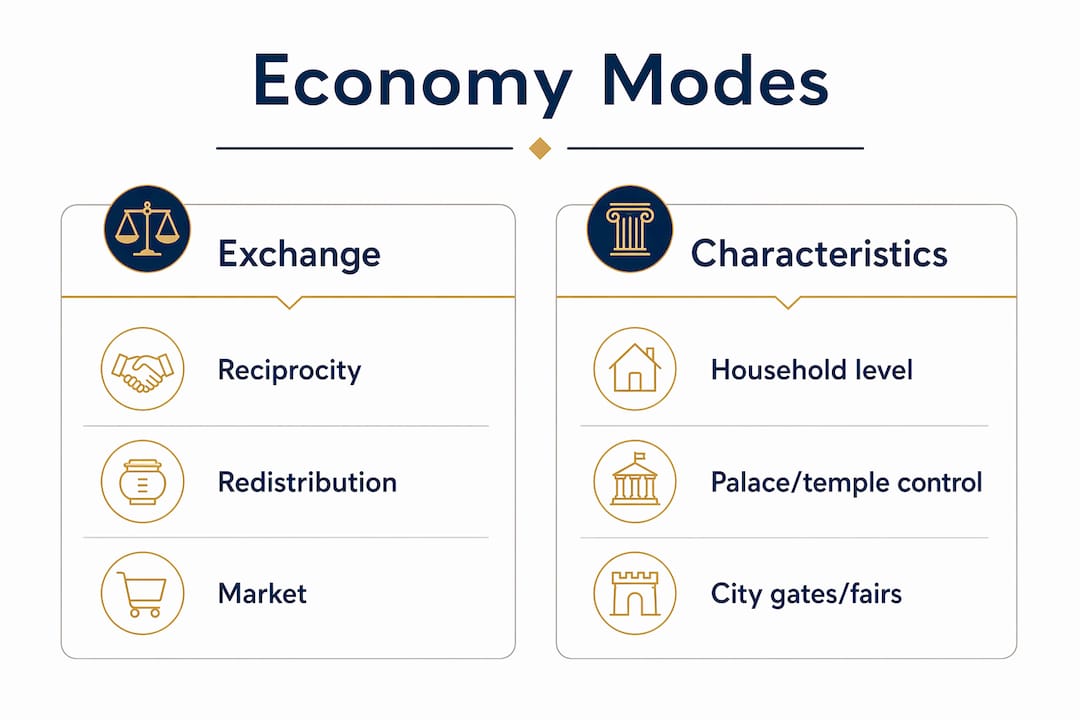
Limited market exchange did exist, primarily at city gates and seasonal fairs, where weighed-metal transactions settled trades in surplus grain, livestock, or craft goods. But calling this a “market economy” misreads the evidence.
What did money and measures actually look like in ancient Israel?
Coined money did not appear in the region until roughly 550 BCE. Before that, every transaction involving precious metal required a balance scale and a set of stone or bronze weights. Archaeology has recovered numerous inscribed weights at Israelite sites from the 8th–7th centuries BCE, confirming that standardized weight systems were real, contested, and legally regulated.
| Unit | Approx. Weight | Notes |
|---|---|---|
| Shekel | a standardized weight | Base unit; regional variants existed (temple shekel, royal shekel) |
| Beka | about half a shekel | Mentioned in Exodus |
| Pim | approximately two-thirds of a shekel | Appears in 1 Samuel 13:21 |
The Torah was explicit: “You shall do no wrong in judgment, in measures of length or weight or quantity. You shall have just balances, just weights” (Leviticus 19:35–36). Deuteronomy 25:13–15 repeats the prohibition on carrying two different weight-sets. Amos 8:5 shows the law was routinely ignored: merchants were caught asking “when will the new moon be over, that we may sell grain? And the Sabbath, that we may offer wheat for sale, making the ephah small and the shekel great?”
Pro Tip: When reading archaeological reports or Bible translations, watch for unit names that shift by region and period. A “shekel” in a Phoenician context may differ from a Judahite royal shekel. Always check whether the source specifies temple, royal, or common standard before comparing figures.
Weight fraud was condemned repeatedly in prophetic and wisdom literature, which tells you something important: the legal standard existed, but enforcement was uneven at best.
How did agriculture shape the Israelite economy’s rhythm?
The agrarian base of ancient Israel rested on three crop pillars: grain (wheat and barley), olives, and grapes, supplemented by figs, dates, and pulses. Each had its own season, its own processing technology, and its own economic logic.
- Grain: Harvested in spring; threshed on communal floors using oxen and sledges; stored in household pits or communal granaries.
- Olives: Pressed in beam oil-presses; oil served as food, fuel, and a major export commodity.
- Grapes: Crushed in rock-cut wine presses; wine was both a local staple and a trade good.
Terracing the hill country was a major capital investment — stone walls built over generations to create flat planting surfaces on steep slopes. Runoff farming channeled seasonal rainfall into these terraces, and plastered cisterns stored water through the dry summer months. Irrigation in the hill country was largely gravity-fed and locally managed, not the palace-controlled canal systems of Mesopotamia or Egypt.
The seasonal labor calendar structured everything: sowing in autumn, grain harvest in spring, grape vintage in late summer, olive harvest in fall. Seasonal village production cycles meant that labor demand spiked and collapsed predictably, shaping when households had surplus cash-equivalents to trade and when they needed credit.
The Shemitah (sabbatical year) mandated that fields lie fallow every seventh year. The gleaning laws (Leviticus 19:9–10) required farmers to leave field edges and fallen produce for the poor. Both functioned as low-cost welfare and ecological management embedded in ritual law rather than administered by a bureaucracy.
How did the palace and temple function as economic institutions?
Palaces and temples were not just religious or political centers. They were fiscal hubs. They collected grain and oil as taxes, managed royal estates with stewards and slave labor, stored commodities in large storage facilities, and provisioned corvée labor gangs building roads and fortifications.
The lemelek jar-stamps are the clearest archaeological evidence for this. These stamped handles on storage jars, reading “belonging to the king,” appear at sites across Judah from the late 8th century BCE. By the 8th century BCE, royal jar-stamps had become a pragmatic tool for reducing transaction costs and standardizing commodity flows under palace control — essentially a quality-assurance mark on royal-grade oil or wine destined for redistribution or export.
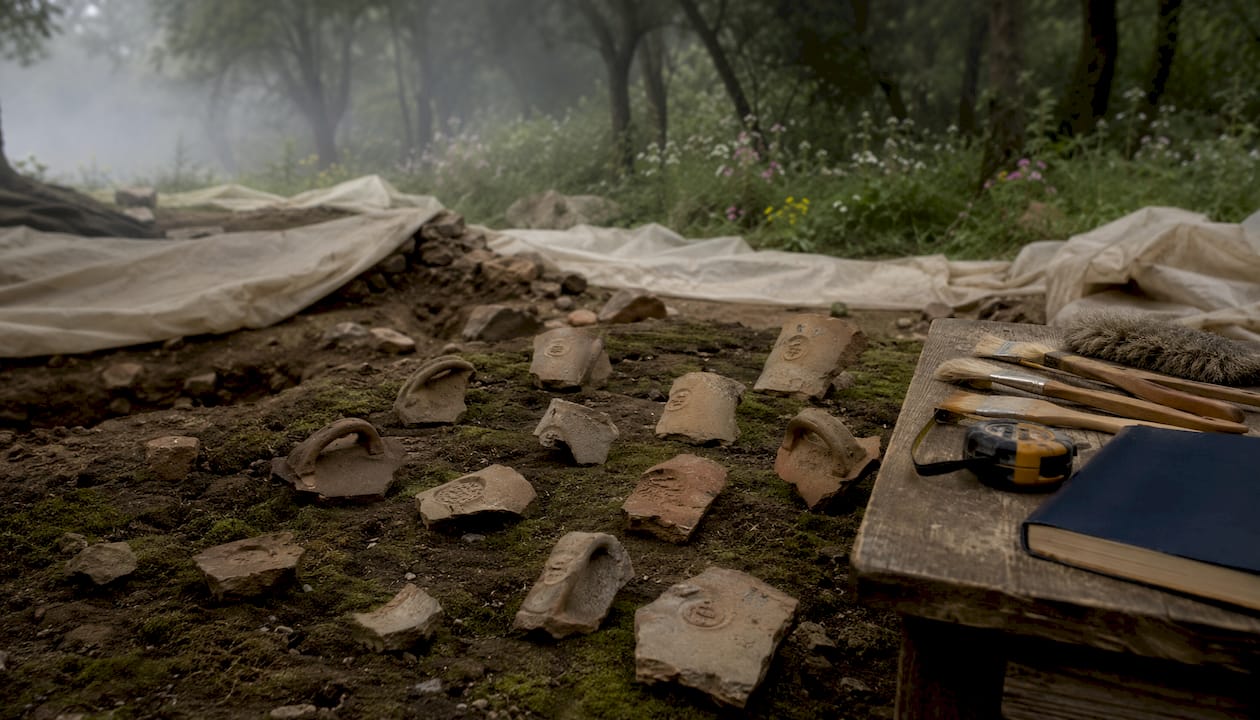
Slavery and forced labor were integral to this system. Military prisoners joined levies of free men in palace construction projects (1 Kings 9:15–22). Royal estates were worked by state-owned slaves and conscripted labor. This was not incidental — it was the labor model that made large-scale redistribution possible.
How did trade work in ancient Israel’s regional network?
Geography was destiny for the ancient Israelite trade system. The coastal plain and the Jezreel Valley formed a natural corridor connecting Egypt to Mesopotamia — what scholars call the Mediterranean superhighway. Israel and Judah sat astride it, which gave them leverage but also made them targets.
Common commodity flows ran roughly like this:
- Imports: Timber (Lebanese cedar), metals (copper, tin, iron), luxury goods (ivory, spices, rare textiles).
- Exports: Olive oil, wine, grain surpluses, and processed agricultural goods.
Royal jar-stamps and standardized weights lowered transaction costs for long-distance buyers by certifying product origin and quality. Ports like Ezion-geber on the Red Sea extended reach to Arabian and African trade networks. Assyrian and Babylonian imperial demands eventually restructured these flows: tribute obligations drained surpluses, and deportations disrupted the skilled labor base that sustained craft production.
What were the social tensions and prophetic critiques?
The core tension ran between subsistence village households and extractive palace and temple demands. Taxation, forced labor, and debt could push a family off its ancestral land entirely — a catastrophe in a system where land was both livelihood and inheritance.
Prophetic literature named this directly. Amos condemned merchants who manipulated weights (8:5) and creditors who sold the poor for a pair of sandals (2:6). Isaiah attacked those who “add house to house and field to field” (5:8). These were not vague moral complaints; they were specific critiques of debt-driven land consolidation.
Demographic shocks compounded the pressure. Assyrian campaigns in the 8th century BCE and Babylonian deportations in the 6th century BCE removed skilled artisans, administrators, and farmers from the productive base. Urbanization under the monarchy had already pulled labor toward palace projects; deportations then stripped villages of the people who remained.
What do biblical laws actually say about economic regulation?
The Torah’s economic legislation was not aspirational poetry. It was a regulatory framework with identifiable economic functions:
- Leviticus 19:35–36: Honest weights and measures — market integrity law.
- Deuteronomy 25:13–15: Prohibition on dual weight-sets — anti-fraud enforcement.
- Leviticus 19:9–10: Gleaning rights — decentralized welfare for the landless poor.
- Deuteronomy 15:1–11: Debt remission every seven years (Shemitah) — credit-market stabilization.
- Leviticus 25: Jubilee land reversion every fifty years — long-term land tenure reset.
Archaeological evidence shows these laws were normative but unevenly enforced. Inscribed weights that deviate from the standard, prophetic condemnations of fraud, and debt-slavery narratives all confirm that the gap between the legal ideal and daily practice was real. The laws mattered precisely because violations were common enough to require repeated prohibition.
Why do demographics and population movements matter here?
Population shifts were economic events, not just political ones. The establishment of the monarchy under Saul, David, and Solomon triggered urbanization that pulled labor from villages into palace construction and administration. That labor shift reduced agricultural output in some regions while concentrating surplus in royal centers.
Assyria’s deportation of northern Israelites after 722 BCE and Babylon’s removal of Judah’s elite after 597 and 586 BCE were deliberate strategies to break productive capacity and prevent rebellion. Skilled craftsmen, administrators, and priests — the people who managed irrigation, kept accounts, and trained apprentices — were specifically targeted. The economic recovery after each deportation took generations, not years.
Conversely, population growth during periods of stability (the 9th–8th centuries BCE under the Omride dynasty in Israel) expanded agricultural output, increased trade volume, and generated the surpluses that funded monumental architecture and long-distance commerce.
How did craft production and artisan guilds function?
Village craft production was embedded in household economies. Most families produced their own pottery, textiles, and basic tools. Specialization emerged where raw materials or skills concentrated: potters near clay deposits, metalworkers near smelting sites, weavers in towns with wool surpluses.
By the Iron Age II period (roughly 1000–586 BCE), evidence for organized craft production appears at several sites. Lachish and Megiddo show large-scale pottery workshops; Tell Beit Mirsim has evidence for a textile industry. The term “guilds” is an anachronism, but family-based craft lineages functioned similarly — passing skills, tools, and client relationships across generations (1 Chronicles 4:21–23 lists families of linen workers and potters as hereditary occupations).
Urban craft production fed both local markets and palace demand. The palace was the largest single buyer of specialized goods: weapons, administrative tools, luxury items, and construction materials. This created a dependency that tied artisan families to royal patronage, reinforcing the redistributive structure of the broader economy.
Key Takeaways
The ancient Israelite economy was agrarian and socially embedded, governed by reciprocity, redistribution, and limited weighed-metal exchange rather than by free markets.
| Point | Details |
|---|---|
| Agrarian foundation | Grain, olives, and grapes drove production; terracing and cisterns enabled hill-country surpluses. |
| Three exchange modes | Reciprocity, palace/temple redistribution, and limited market exchange coexisted at different social scales. |
| Weights, not coins | The shekel was a standardized weight unit; numerous inscribed weights confirm standardized but fraud-prone systems. |
| Temple and palace as fiscal hubs | Lemelek jar-stamps and storage facilities show centralized collection and redistribution of commodities. |
| Joshthinks application | Joshthinks connects these historical findings to faith-based economic frameworks for modern congregations and readers. |
What this history actually demands of us
Most modern readers approach biblical economics looking for policy prescriptions — a divine endorsement of markets, or socialism, or something in between. That search misreads the texts. The Torah’s economic laws were not a universal economic theory. They were contextual regulations for a specific agrarian society facing specific pressures: land consolidation, debt cycles, weight fraud, and extractive imperial demands.
What does transfer across the millennia is the underlying logic: economic arrangements should protect the vulnerable, maintain ecological sustainability, and prevent the permanent concentration of productive resources in a few hands. The gleaning law is not a template for modern food banks. It is evidence that the biblical tradition considered access to subsistence a social right, not a charity. That principle travels.
The Polanyi-informed reading matters here because it resists the temptation to baptize any modern economic system as “biblical.” Ancient Israel’s economy was embedded in covenant and kinship, not in price signals. Recognizing that gap is the beginning of honest engagement with what the texts actually say — and what they actually demand.
Joshthinks goes deeper on biblical economics
If this history raises questions about how those ancient principles apply today, Joshthinks has built a library of resources that take the next step. The Christian economics guide connects the historical framework to modern stewardship and congregational finance. The biblical fair labor guide translates the Torah’s labor protections into practical questions for employers and workers today.

For readers who want to understand how ancient economic logic connects to modern markets, the Joshthinks finance and markets library covers everything from futures trading mechanics to the structural parallels between ancient redistribution systems and modern fiscal policy. The same analytical rigor that grounds this historical piece runs through every guide on the site. Start with the topic that connects most directly to your own questions, and follow the thread from there.
Useful sources and further reading
The sources below represent a mix of primary texts, archaeological summaries, and interpretive scholarship. Each is worth consulting for the specific dimension it covers.
| Source | Why it’s useful |
|---|---|
| Economy and Exchange in the Iron Age Kingdoms of the Southern Levant | Master’s framework for three exchange institutions (kingdom, market, trade route) — the best single scholarly entry point. |
| Institutions of Trade in 1 and 2 Kings | Detailed analysis of Mediterranean trade corridors and how geography shaped Israelite commerce. |
| Economic Life, Holman Bible Dictionary | Accessible overview of agricultural, urban, and trade dimensions of the biblical economy. |
| Iron Age Economic Modes, Bible Interp (Nam) | Applies Polanyi’s social-embeddedness framework to Iron Age Levant data — essential for the reciprocity/redistribution argument. |
| Shekel Standardization, Biblexika | Covers weight archaeology, unit variants, and the legal/prophetic response to fraud. |
| American Bible Society: Ancient Israelites and Agriculture | Clear summary of gleaning, Shemitah, and agricultural law as welfare and ecological policy. |
| Agricultural Land Management, Encyclopedia.com | Covers terracing, cisterns, and local water management in the hill country. |
| Temin: Institutional Trade History | Analyzes jar-stamps and royal administrative tools as transaction-cost-reducing institutions. |
| Primary texts: Leviticus 19, 25; Deuteronomy 15, 25; Amos 8 | The legal and prophetic sources themselves — read alongside a critical commentary for full context. |


