Why Generosity Is a Spiritual Discipline for Christians
Why generosity is a spiritual discipline in Christianity
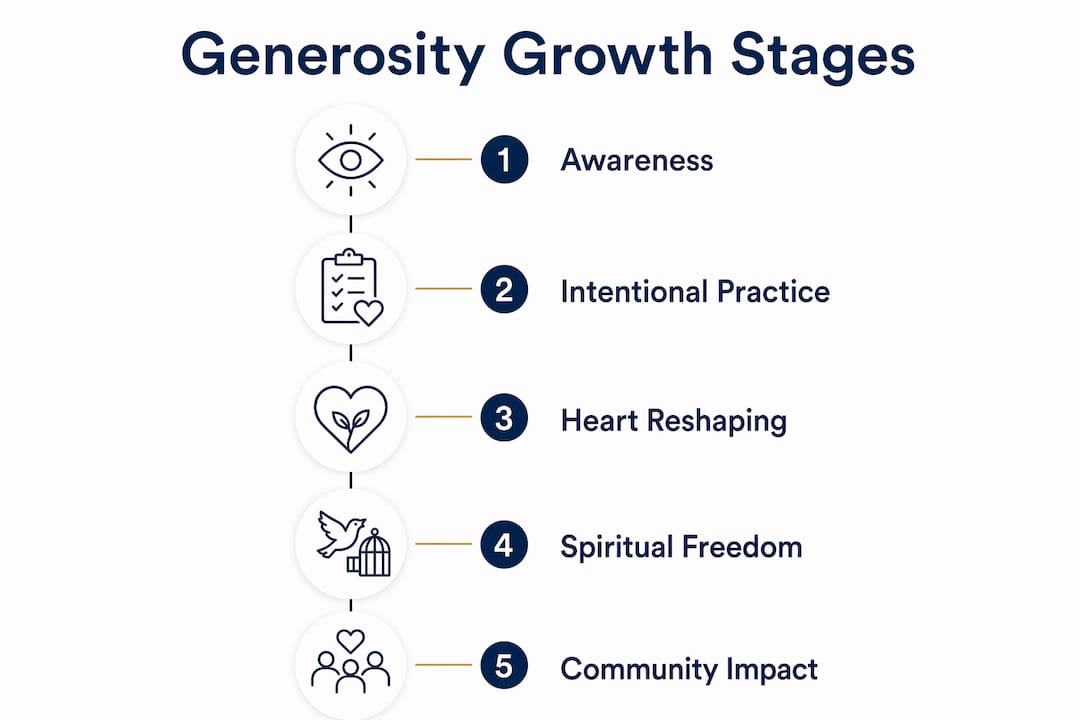
Generosity is a spiritual discipline because it is an intentional, repeated practice that reshapes the heart, not merely a good deed done when the mood strikes. Like prayer or fasting, it requires deliberate effort, and that effort is precisely what makes it formative. When you give systematically and joyfully, you are training yourself to trust God rather than your bank account.
What separates Christian generosity from secular giving is the posture behind it. Secular giving can be motivated by tax benefits, social approval, or personal satisfaction. Christian generosity, by contrast, flows from a heart already secured in Christ. You give because you have received grace, not to earn it.
The key characteristics that make generosity a genuine spiritual discipline:
- Intentionality: Giving is planned and purposeful, not reactive or impulsive.
- Joy: Paul’s instruction in 2 Corinthians 9 calls for a cheerful giver, one who has settled the matter internally before the offering plate arrives.
- Faith: Every act of giving is a small declaration that God provides, and that you do not need to hoard.
- Stewardship: Christians hold resources as managers, not owners, which reframes every financial decision as a spiritual one.
- Dependence on God: Generosity trains the heart away from self-sufficiency and toward reliance on God’s provision.
Practiced consistently, generosity as a spiritual discipline places Jesus first, frees the giver from the grip of money, and produces the kind of spiritual formation that no amount of passive belief can replicate.

What does the Bible say about giving as a spiritual practice?
The biblical case for generosity as a discipline is built on two pillars: motive and method.
Jesus addresses motive directly in Matthew 6. He warns against giving publicly to win human praise, calling that behavior its own reward, a transaction with people rather than God.
“But when you give alms, do not let your left hand know what your right is doing, so that your almsgiving may be secret. And your Father who sees in secret will repay you.”
— Matthew 6:3–4, USCCB
The point is not that giving should be hidden for its own sake. The point is that giving done for an audience is no longer an act of worship. It becomes performance. Jesus pairs this teaching on giving with his instructions on prayer and fasting, which signals that he treats generosity as an embodied spiritual practice in the same category as those disciplines, one that disciplines attachments and reshapes trust.
Paul addresses method in 2 Corinthians 9. His instruction is not to give under pressure or out of guilt, but from a prior, settled decision of the heart.
“Each must do as already determined, without sadness or compulsion, for God loves a cheerful giver. Moreover, God is able to make every grace abundant for you, so that in all things, always having all you need, you may have an abundance for every good work.”
— 2 Corinthians 9:7–8, ESV
That phrase “already determined” is theologically loaded. Cheerful giving is not an emotional high. It is the fruit of reflection, prayer, and a will aligned with God’s purposes. The discipline is in the deciding, long before the giving happens. Paul adds that God supplies the giver so that more giving becomes possible, which frames generosity not as depletion but as participation in a cycle of grace. For a deeper look at how biblical stewardship principles connect to this framework, Joshthinks covers the theological ground in detail.
How practicing generosity shapes your spiritual growth
Generosity does something to the giver that no amount of reading about it can replicate. Richard J. Foster, writing in The Challenge of the Disciplined Life, argues that lavish, joyful giving is a direct antidote to spiritual dryness. When Bible study feels like homework and prayer feels hollow, giving breaks the inward spiral. It reorients attention outward and upward.
The mechanism is not mysterious. Money, as Foster puts it, is “coined personality.” It represents your time, your labor, and your sense of security. When you give it away, you are releasing a piece of yourself. That release is exactly what Jesus calls for in Luke 9:23, denying self and taking up the cross daily. Generosity is one of the most concrete ways to obey that command.
Pro Tip: If your devotional life feels stale, try committing to a specific, planned gift before your next time of prayer. Many Christians find that the act of giving reactivates their sense of dependence on God in a way that reshapes the prayer that follows.
Jesus places giving alongside prayer and fasting in Matthew 6 for a reason. All three disciplines train believers to trust God for provision and resist the pull of material attachment. Fasting says “I do not live by bread alone.” Generosity says “I do not live by accumulation alone.” Both reshape desire at the level of habit, not just intention.
Generosity also counters a specific spiritual danger: the slow drift toward self-spending. When you consistently give, you are laying down the appetite to consume everything for yourself. That appetite does not disappear on its own. It has to be trained out, and generosity is one of the primary tools for doing it.
How churches can form a culture of generosity over time
Most churches approach giving as a fundraising problem. The Presbyterian Foundation’s research on reframing stewardship as a spiritual discipline points to a different question entirely: not “how do we get people to give more?” but “how does generosity deepen people’s relationship with God?”
Trinity Presbyterian Church offers a concrete example. Their leadership devoted an extended period to intentional formation around generosity, using five specific steps:
- Discernment: Identifying what shaped the congregation’s existing theology of giving before trying to change it.
- Scripture study: Thirteen weeks of guided study through passages including Genesis 45, Exodus 16, Psalm 25, Matthew 6, and Ephesians 3, all centered on the theme of God providing.
- Prayer: Woven throughout, not added as an afterthought.
- Personal testimony: Monthly three-minute video stories from congregation members sharing how they learned to be generous.
- Repetition: The same scriptures and themes communicated across social media, newsletters, worship, and announcements simultaneously.
One of the most telling details from Trinity’s journey: it took several years for the congregation to fully embrace the language shift from “stewardship committee” to “generosity and finance committee.” That was not semantics. It was a necessary reframing of the entire paradigm.
| Formation Step | Purpose | Timeframe |
|---|---|---|
| Discernment | Identify current theology of giving | Weeks 1–4 |
| Scripture study | Build biblical foundation | 13 weeks |
| Prayer | Sustain spiritual grounding | Ongoing |
| Personal testimony | Normalize generosity stories | Monthly |
| Repetition | Embed new mindset across channels | Year-round |
The lesson is that mindset change around generosity is slow and requires patience. Quick campaigns and annual pledge drives rarely produce lasting formation. The conversation about money in your church community has to be ongoing, grounded in Scripture, and framed around relationship with God rather than institutional need.
How biblical and economic thinking converge in Christian generosity
Christian generosity is not just a spiritual posture. It functions as a form of resource redistribution with real economic consequences, and understanding both dimensions together gives the discipline its full weight.
From an economic standpoint, generosity moves resources from those with surplus to those with need. The early church in Acts 4 practiced this literally, with members selling property and land to fund the community. That was not charity in the modern sense. It was a theological statement about ownership: everything belongs to God, and the community holds it in trust.
- Generosity counters hoarding. Hoarding concentrates resources and erodes community trust. Biblical generosity deliberately breaks that pattern, redistributing both material goods and the social bonds that come with them.
- Generosity aligns believers with grace. God’s economy operates on abundance, not scarcity. Giving reflects a belief that God’s supply does not run out, which is a direct challenge to the scarcity mindset that drives most financial anxiety.
- Generosity functions as worship. Placing the offering within the worship service is theologically intentional. It signals that giving is not a transaction but an act of devotion, integrated into the same rhythm as prayer and proclamation.
“The grace of giving is often a tremendous stimulant to the life of faith. This is why the offering is correctly placed as part of the worship experience.”
— Richard J. Foster, Renovaré
Joshthinks explores this intersection directly, connecting faith-driven generosity economics with biblical principles of stewardship and community. The argument is that you cannot fully understand Christian giving without understanding both its theological roots and its practical economic function. One without the other produces either sentimentality or mere philanthropy, neither of which is what Scripture describes.
How generosity developed as a discipline through Christian history
The early church did not invent generosity as a concept, but it gave it a distinctly theological shape. In the first and second centuries, Christian communities were known throughout the Roman world for their care of the poor, including people outside their own congregations. Writers like Tertullian noted that pagans observed Christians’ mutual care with surprise: “See how they love one another.”
The Desert Fathers of the third and fourth centuries treated almsgiving as a core ascetic practice, placing it alongside fasting and prayer as a discipline that stripped away attachment to the material world. John Chrysostom, the fourth-century Archbishop of Constantinople, preached repeatedly that the wealthy Christian who hoarded while the poor starved was committing a form of theft. For Chrysostom, generosity was not optional charity. It was justice, rooted in the image of God present in every person.
The medieval church institutionalized giving through tithing requirements and the works of mercy, but this also introduced a distortion: giving became entangled with merit, with the idea that alms could purchase divine favor or reduce time in purgatory. The Reformation pushed back hard against this. Martin Luther and John Calvin both argued that giving must flow from grace received, not grace earned. Calvin’s theology of stewardship, the idea that believers are managers of God’s resources rather than owners, became foundational for Protestant approaches to generosity.
By the nineteenth century, figures like John Wesley were preaching a three-part rule: earn all you can, save all you can, give all you can. Wesley himself reportedly gave away the vast majority of his income throughout his life. This was not asceticism for its own sake. It was a disciplined response to the conviction that money held loosely is money held rightly.
Common misconceptions about generosity in Christian practice
Misconception 1: Generosity is primarily about money.
Giving money is one expression of generosity, but the discipline is broader. Time, skill, attention, and hospitality all fall within its scope. Richard Foster notes that doctors, lawyers, and other professionals can give their skills away as a form of generosity. The heart posture matters more than the currency.
Misconception 2: Generous giving requires wealth.
The widow’s offering in Mark 12 is the clearest biblical rebuttal to this idea. Jesus commends her two small coins over the large gifts of the wealthy, because she gave from her poverty rather than her surplus. Generosity, as Hillsdale College’s Core Virtues project defines it, is measured by willingness to give, not by the amount given.
Misconception 3: Giving should always feel good.
Paul’s instruction to give cheerfully is sometimes read as a requirement to feel happy while giving. But cheerfulness in 2 Corinthians 9 describes a settled will, not an emotional state. You can give faithfully through reluctance, grief, or uncertainty. The discipline is in the decision, not the feeling.
Misconception 4: Generosity is a personality trait, not a practice.
Some Christians assume they are simply “not wired” for generosity. But Scripture treats it as a virtue that can be cultivated, not a fixed character trait. The formation steps Trinity Presbyterian used, scripture, prayer, testimony, and repetition, exist precisely because generosity has to be grown over time.
Misconception 5: Church fundraising campaigns are the same as generosity formation.
This is perhaps the most damaging misconception. Campaigns raise money. Formation shapes people. The Presbyterian Foundation’s research makes clear that many churches focus on the former while neglecting the latter, producing givers who respond to appeals but never develop a lasting generosity rhythm.
How generosity builds community and fellowship in the church
Generosity is not only a vertical practice between the believer and God. It has a horizontal dimension that shapes the entire life of a congregation.
When members give to one another, whether financially, through time, or through hospitality, they are enacting the body-of-Christ theology that Paul describes in 1 Corinthians 12. No member is self-sufficient. Every member depends on the others. Generosity makes that interdependence visible and tangible.
The early church in Acts 2 and Acts 4 is the clearest historical example. Members sold property and distributed proceeds according to need. The result was not just financial stability. It was a community marked by unity, joy, and credibility in the surrounding culture. People outside the church took notice. Generosity was the visible sign of an invisible grace.
Within a congregation, a culture of generosity also reduces the shame and isolation that financial hardship produces. When giving is normalized and celebrated as a spiritual practice rather than a private transaction, it creates space for honest conversation about money, need, and provision. That honesty is itself a form of fellowship.
Trinity Presbyterian’s experience confirms this. Their generosity formation process was not primarily about the budget. It was about deepening relationships, both with God and with each other. The pastor’s stated goal was never to get more money. It was to help people grow in their relationship with God, and generosity turned out to be one of the most direct paths to that growth.
Key Takeaways
Generosity is a spiritual discipline because it intentionally reshapes the heart’s trust, training believers to depend on God rather than accumulate for themselves.
| Point | Details |
|---|---|
| Intentionality defines the discipline | Generosity practiced systematically, not impulsively, is what makes it spiritually formative rather than occasional charity. |
| Scripture grounds the motive | Matthew 6 and 2 Corinthians 9 both anchor giving in a settled heart posture, not emotional highs or public performance. |
| Formation takes time | Trinity Presbyterian spent a full year on intentional generosity formation before the congregation’s mindset began to shift. |
| Giving reshapes spiritual vitality | Richard J. Foster identifies lavish, joyful giving as a direct remedy for spiritual dryness and hollow devotion. |
| Community is shaped by generosity | A congregation that practices generosity together builds the kind of trust and interdependence that reflects the body of Christ. |
Joshthinks explores the intersection of faith, economics, and history for readers who want more than surface-level answers. If you are thinking about how biblical principles apply to your financial life, the Finance & Markets section is a good place to start.