

What Does Scripture Say About Inequality?
Scripture defines human equality as a theological fact, not a political preference. Every person carries the image of God, which grants inherent worth regardless of wealth, ethnicity, or social rank. The Bible does not treat inequality as a modern policy debate. It addresses the root causes directly: sinful human hearts, corrupt systems, and the failure to love neighbors as ourselves. Understanding what does scripture say about inequality gives believers a clear framework for both personal conviction and community action. This guide walks through the biblical foundations, the New Testament’s radical claims, and the practical steps scripture calls you to take.
What does scripture say about inequality at its foundation?
The Bible’s answer to inequality starts in Genesis, not in politics. Genesis 1:27 teaches that God created every human in His own image. That single verse is the most powerful equality statement ever written. It means no person is inherently worth more than another, regardless of their bank account, nationality, or social standing.
God’s own character reinforces this. Romans 2:11 states that God shows no favoritism. He does not grade people by their zip code or their title. That truth directly challenges every system that assigns human worth based on wealth or status.
The theological term for this foundation is Imago Dei, Latin for “image of God.” You do not need to use the Latin to understand the weight of it. It means:
- Every person you meet carries a dignity that cannot be earned or taken away.
- Poverty does not diminish a person’s worth before God.
- Wealth does not elevate a person’s worth before God.
- Ethnic and social divisions have no standing in God’s moral order.
These are not soft suggestions. They are the bedrock claims of biblical anthropology. Any honest reading of scripture on inequality must start here.
How does Galatians 3:28 reshape social and economic divisions?
The New Testament does not soften the Old Testament’s equality claims. It sharpens them. Galatians 3:28 declares that there is neither Jew nor Greek, slave nor free, male nor female, because all are one in Christ Jesus. That verse was written into a culture where those distinctions defined everything: legal rights, social access, and economic opportunity.

Paul’s point is not that differences disappear. Men and women still exist. Ethnic backgrounds still exist. His point is that none of those differences determine your standing before God or your worth within the community of faith. That is a radical claim in any century.
The early church took this seriously in practical terms. They did not just preach unity. They lived it out economically and socially. Here is what that looked like in the first century:
- Shared resources. Acts 4:32 records that all believers held possessions in common so that no one among them was in need. This was voluntary, not coerced.
- Communal meals. Jews and Gentiles, who had never eaten together under Jewish law, shared the same table in Christ.
- Mutual accountability. Wealthier members gave to poorer members without expectation of repayment.
- Cross-cultural leadership. The early church appointed leaders from multiple ethnic backgrounds, including Africans and Greeks.
Pro Tip: Read Acts 2:44–45 and Acts 4:32–35 together. They show a community where spiritual unity produced economic generosity, not the other way around. The theology came first; the sharing followed.
Believers today can draw a direct line from Galatians 3:28 to how they treat people in their own churches, workplaces, and neighborhoods.
What are the biblical commands for justice and impartial judgment?
Scripture does not leave justice as an abstract ideal. It gives specific commands. Leviticus 19:15 forbids perverting justice by showing favoritism to either the poor or the powerful. That verse is striking because it cuts both ways. Biblical justice is not about favoring the underdog to balance the scales. It is about applying God’s moral law equally to everyone.
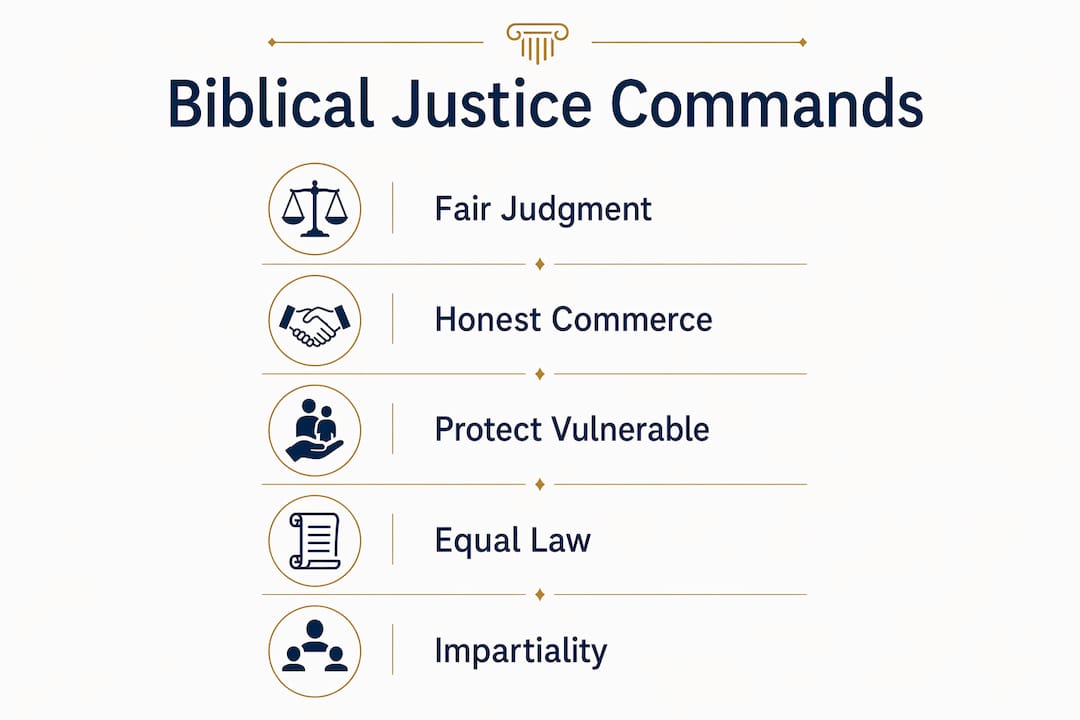
Deuteronomy 25:13–15 prohibits dishonest weights and measures in commerce. That was the ancient equivalent of price manipulation, wage theft, or fraudulent contracts. Honest trade is not just good economics in scripture. It is a moral obligation tied directly to God’s character.
Scripture also builds in specific protections for vulnerable groups. The Bible names them repeatedly: orphans, widows, foreigners, and the poor. These are not afterthoughts. They are central to the legal and prophetic tradition.
| Biblical command | Who it protects | Practical application |
|---|---|---|
| Leviticus 19:9–10 (leave gleanings) | The poor and the foreigner | Giving access to resources, not just charity |
| Proverbs 31:9 (speak up for the needy) | Those without a voice | Advocacy and fair representation |
| Deuteronomy 25:13–15 (honest weights) | All parties in commerce | Fair wages, honest pricing, transparent contracts |
| Leviticus 19:15 (impartial judgment) | Rich and poor alike | Equal legal treatment regardless of status |
Pro Tip: Notice that biblical justice protects both the poor from exploitation and the rich from mob partiality. True justice is not class warfare. It is consistent application of God’s standard.
Biblical justice demands equal application of God’s moral law to everyone, not equality of outcomes. That distinction matters enormously when you are trying to apply scripture to modern debates about economic disparity.
How did biblical communities practice economic fairness?
The Bible does not just describe economic justice in theory. It builds it into law and community practice. Leviticus 19:9–10 commands farmers to leave the edges of their fields unharvested and to not pick up fallen grapes. The poor could come and gather what remained. This system, called gleaning, was not charity. It was structured access to resources built into the economic system itself.
Acts 4:32 records that the early Christian community shared possessions so that no one was in need. This was not communism imposed by the state. It was voluntary generosity driven by spiritual conviction. The difference matters. Mandated redistribution and voluntary generosity both address need, but they come from entirely different motivations and produce different community dynamics.
Paul’s letters add another layer. He taught believers to be faithful stewards of what they had, to give generously, and to avoid both greed and covetousness. His biblical resource sharing model was rooted in gratitude, not guilt.
- Gleaning laws gave the poor dignity. They worked for what they received rather than waiting for a handout.
- Early church sharing was relational. Givers knew the people they helped.
- Paul’s stewardship teaching made generosity a spiritual discipline, not a tax.
- The Jubilee laws in Leviticus 25 reset land ownership every 50 years, preventing permanent concentration of wealth.
These examples show that scripture takes economic fairness seriously at both the individual and community level. You can study biblical community living principles to see how these ancient practices translate into modern faith community life.
How can believers apply biblical teachings on inequality today?
Scripture gives you a clear framework for living out these truths. It does not require you to have a political platform. It requires you to have a changed heart and consistent behavior.
- Reflect God’s impartiality. Treat every person you encounter with the dignity their Imago Dei demands. That means the homeless man outside your church gets the same respect as the major donor inside it.
- Practice honest commerce. If you own a business, pay fair wages. If you manage contracts, write them honestly. Deuteronomy’s prohibition on dishonest weights applies directly to modern economic life.
- Speak up for the vulnerable. Proverbs 31:9 calls you to open your mouth and judge fairly, to defend the poor and needy. That is advocacy rooted in scripture, not political ideology.
- Give generously and relationally. The early church model was personal. Know the people you help. Give in ways that preserve dignity.
- Check your own heart. Covetousness and envy are root sins that drive inequality. Scripture calls you to address those in yourself before you address them in systems.
Micah 6:8 summarizes the entire framework in one verse: act justly, love mercy, and walk humbly with God. Justice without mercy becomes cold legalism. Mercy without justice becomes enabling. Humility keeps both in check.
Pro Tip: Micah 6:8 is not a political slogan. Read it in context. It was addressed to people who performed religious rituals while exploiting the poor. The call is to internal transformation first, then external action.
Performative piety undermines true biblical justice. Believers must focus on authentic acts of mercy and humility rather than public displays designed to signal virtue. The biblical lens on economic justice at Joshthinks explores how these principles apply to contemporary economic decisions in more depth.
Key Takeaways
Scripture teaches that every person holds equal worth before God and that believers are called to practice impartial justice, honest commerce, and genuine generosity toward the marginalized.
| Point | Details |
|---|---|
| Imago Dei as foundation | Genesis 1:27 grants every person equal inherent worth, regardless of wealth or status. |
| Impartial justice | Leviticus 19:15 forbids favoritism toward both the rich and the poor in judgment. |
| Honest commerce | Deuteronomy 25:13–15 makes fair trade a moral obligation, not just good practice. |
| Voluntary generosity | Acts 4:32 shows economic sharing driven by spiritual conviction, not state mandate. |
| Justice plus mercy | Micah 6:8 holds justice and mercy together, preventing both cold legalism and enabling. |
What I have learned about scripture and inequality that most people miss
Most people approach the Bible’s teaching on inequality from one of two broken starting points. Either they use scripture to justify the status quo, or they strip-mine it for political ammunition. Both approaches miss the point entirely.
What strikes me most after years of studying these texts is how personal the Bible’s demands are. It does not primarily address inequality through legislation. It addresses it through transformed individuals who then build transformed communities. The early church in Acts did not lobby Rome for wealth redistribution. They simply started sharing with each other, and the watching world took notice.
Social inequality is ultimately a symptom of sinful human nature. That means political solutions alone will never fix it. They can reduce harm, and that matters. But the root requires spiritual transformation, not just policy change. Believers who understand this are freed from the exhausting cycle of political outrage. They can act locally, give personally, and advocate faithfully without tying their hope to election outcomes.
The tension between justice and mercy that Micah 6:8 describes is not a problem to solve. It is a posture to maintain. The moment you drop either one, you drift into something that is no longer biblical. That balance is harder than any political platform, and it is far more durable.
— Josh
Joshthinks: Where faith meets economic understanding
Joshthinks covers the intersection of faith, finance, history, and politics with the kind of depth that most platforms skip. If this article raised questions about how biblical principles connect to real economic decisions, the biblical economic frameworks guide at Joshthinks breaks down the major models scripture offers for thinking about money, stewardship, and justice.

Joshthinks also covers the financial side of these questions directly. Whether you are thinking about how faith shapes investment decisions or how Christian economics applies to personal financial planning, the Finance and Markets section connects scripture to the real world of money in ways that are practical and grounded.
FAQ
What does the Bible say about poverty and the poor?
Scripture commands believers to defend the poor, provide for their needs through structured access to resources, and speak up for those without a voice. Proverbs 31:9 and Leviticus 19:9–10 both treat care for the poor as a moral obligation, not an optional act of charity.
Does the Bible support equality of outcomes?
Biblical justice demands equal application of God’s moral law to everyone, not enforced equality of results. Scripture calls for impartial judgment and honest commerce, not guaranteed equal wealth.
What is the difference between biblical justice and social equity?
Biblical justice applies God’s moral standard equally to all people without favoritism. Social equity typically aims at equal outcomes. Scripture supports the first and does not mandate the second, though it does call for generous care of those in need.
How does Galatians 3:28 apply to social inequality today?
Galatians 3:28 removes ethnic, social, and gender hierarchies as criteria for human worth or access to God. It calls believers to treat every person with equal dignity inside and outside the church, regardless of social or economic status.
Is addressing inequality a spiritual issue or a political one?
Advocacy rooted in scripture aims at spiritual repentance and transformed communities rather than political solutions alone. Scripture treats inequality as a symptom of sin, which means the deepest response is spiritual transformation, not just policy change.


